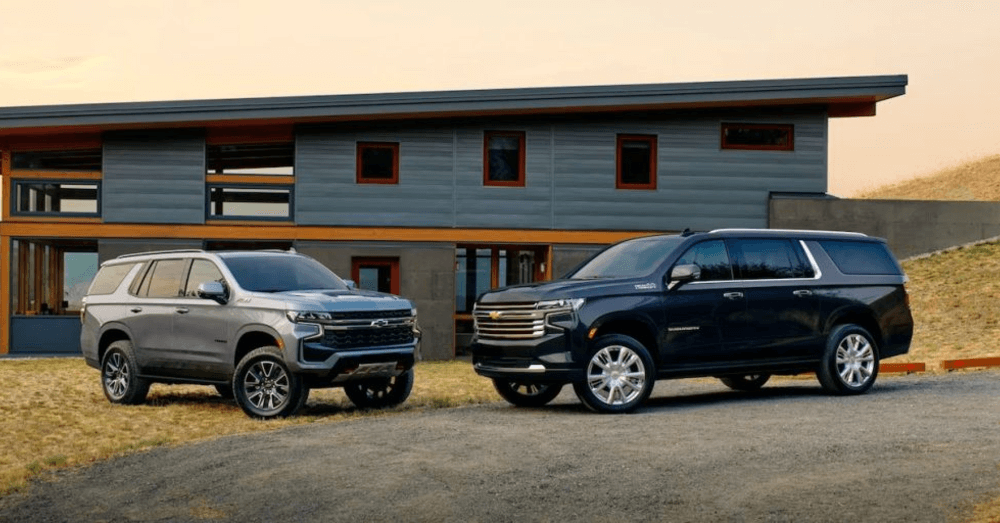
The 2026 Chevrolet Tahoe and Suburban share a lot of DNA, including engines, tech, and trim levels. But once you look past the surface, these two full-size SUVs cater to different buyers in some pretty meaningful ways. Whether you’re hauling a large family on road trips or towing a boat to the lake every weekend, understanding the 2026 Chevrolet Tahoe vs Chevrolet Suburban differences can save you thousands and point you toward the right fit.
- The Tahoe starts at $60,700 and maintains a $3,000 price advantage over the Suburban across every trim level.
- The Suburban offers 41.5 cubic feet of cargo space behind the third row, compared to 25.5 cubic feet in the Tahoe.
- The Tahoe edges out the Suburban in towing, pulling up to 8,400 pounds with its 5.3-liter V8 and rear-wheel drive, which is 100 pounds more than an identically equipped Suburban.
Price Gap Across the Entire Lineup
Budget matters, especially when you’re shopping in the $60,000-plus range. The base MSRP for the 2026 Chevy Tahoe LS with two-wheel drive is $60,700. The Suburban LS 2WD, meanwhile, starts at $63,700. That $3,000 gap doesn’t shrink as you move up the ladder, either. No matter which trim you choose, the Tahoe keeps its $3,000 advantage over the Suburban. The High Country models, for example, are priced from $80,700 and $83,700 respectively.
Both SUVs come in six trim levels, from the base LS up to the top-tier High Country, with the same feature set at each price point. The Suburban’s premium really comes down to its larger body.
Size and Cargo Space Tell the Real Story
The Suburban measures 226.3 inches long compared to 211.3 inches for the Tahoe. That 15-inch difference might not sound like much on paper, but it makes a world of difference when you’re packing for a family vacation or trying to fit sports equipment behind the third row.
With the third row upright, the Suburban offers 41.5 cubic feet of cargo space, easily dwarfing the Tahoe’s 25.5 cubic feet. Fold the third row down, and the Suburban opens up to 93.8 cubic feet versus 72.5 in the Tahoe. With both rear rows stowed, the Suburban stretches to 144.7 cubic feet, leaving the Tahoe and its 122.7 cubic feet behind.
Headroom stays the same across both models, and front and second-row legroom, shoulder room, and hip room are identical. The difference begins with third-row legroom, where the Suburban offers 36.7 inches compared to the Tahoe’s 34.9 inches. If your family includes adults who regularly sit in that back row, those extra inches could mean the difference between comfortable and cramped.
Towing, Engines, and Driving Dynamics
Both the Tahoe and Suburban share three engine options: the Duramax 3.0L Turbo Diesel with 305 horsepower and 495 lb.-ft. of torque, the 5.3L EcoTec3 V8 with 355 horsepower and 383 lb.-ft. of torque, and the 6.2L EcoTec3 V8 with 420 horsepower and 460 lb.-ft. of torque. A 10-speed automatic transmission comes standard on both.
Where they split is on the scales. The Suburban is heavier than the Tahoe (5,723 vs. 5,580 pounds), which may affect fuel efficiency when fully loaded. That lower curb weight gives the Tahoe a slight towing edge. The maximum available towing capacity of the 2026 Chevy Tahoe is 8,400 lbs. The Suburban maxes out at 8,200 lbs.
When equipped with the 3.0-liter Duramax turbo diesel, the Tahoe and Suburban can tow 8,200 and 7,800 lbs., respectively. The gap isn’t huge, but if you’re frequently towing close to the limit, those extra pounds of capacity could matter.
The Tahoe also wins in maneuverability. Its shorter body and tighter turning radius make it easier to park and handle in everyday driving. Anyone who’s tried squeezing a Suburban into a downtown parking garage knows the struggle is real.
Shared Tech That Keeps Both SUVs Connected
Inside, the Tahoe and Suburban offer identical setups, with a 17.7-inch touchscreen display and an 11-inch digital instrument cluster. Apple CarPlay, Android Auto, and a wireless smartphone charging pad come standard as well. Tri-zone automatic climate control is included on every trim, but you’ll need to step up past the base model for heated front seats.
Google Maps, the Google Play store, and Google Assistant voice commands are built in. Both SUVs also offer available Super Cruise hands-free driving on compatible roads and a connected camera system for remote vehicle monitoring through the MyChevrolet app.
Tahoe or Suburban for Your Next Road Trip?
This decision really comes down to how you’ll use the vehicle day to day. If you need more cargo space or plan on seating adults in the third row, the Suburban has a clear advantage. If you’re looking to spend less, want a bit more towing capacity, or prefer better maneuverability, the Tahoe is the stronger pick.
For families of five or fewer who tow regularly and want a full-size SUV that’s a little easier to park, the Tahoe checks all the boxes. Got a bigger crew, more gear, and longer road trips? The Suburban earns its $3,000 premium with all that extra space. Both seat seven to nine passengers depending on configuration, so either one can handle a crowd. The question is how comfortable that crowd will be and how much stuff you need to bring along.